OnePlus did it again. Its latest phone, the OnePlus 5T, pairs the right high-end hardware and software with the right price, making it one of the best value phones you can buy anywhere. It remains one of those rare devices that can take on phones with slightly brawnier specs and higher price tags like the Galaxy Note 8 ($929.99 at Amazon.com) and LG V30 ($800.00 at T-Mobile USA). That price-to-value ratio is exactly the reason why the 5T, like the last OnePlus phones before it, is one of the best mid-priced phones you can buy and earned CNET's Editor's Choice Award.

It's not perfect, of course -- no phone is. One of the OnePlus 5T's biggest warts is that it's only an incremental hop from the OnePlus 5 ($949.98 at Amazon.com) we saw just five months ago. So, while the 5T is genuinely impressive for new buyers, anyone who already owns a OnePlus 5 can join me in a big shrug.
In fact, OnePlus 5 owners have a right to be annoyed that their phone is now "old news." (And OnePlus no longer sells the 5, so unless you're buying it through another channel, this is your only option.)
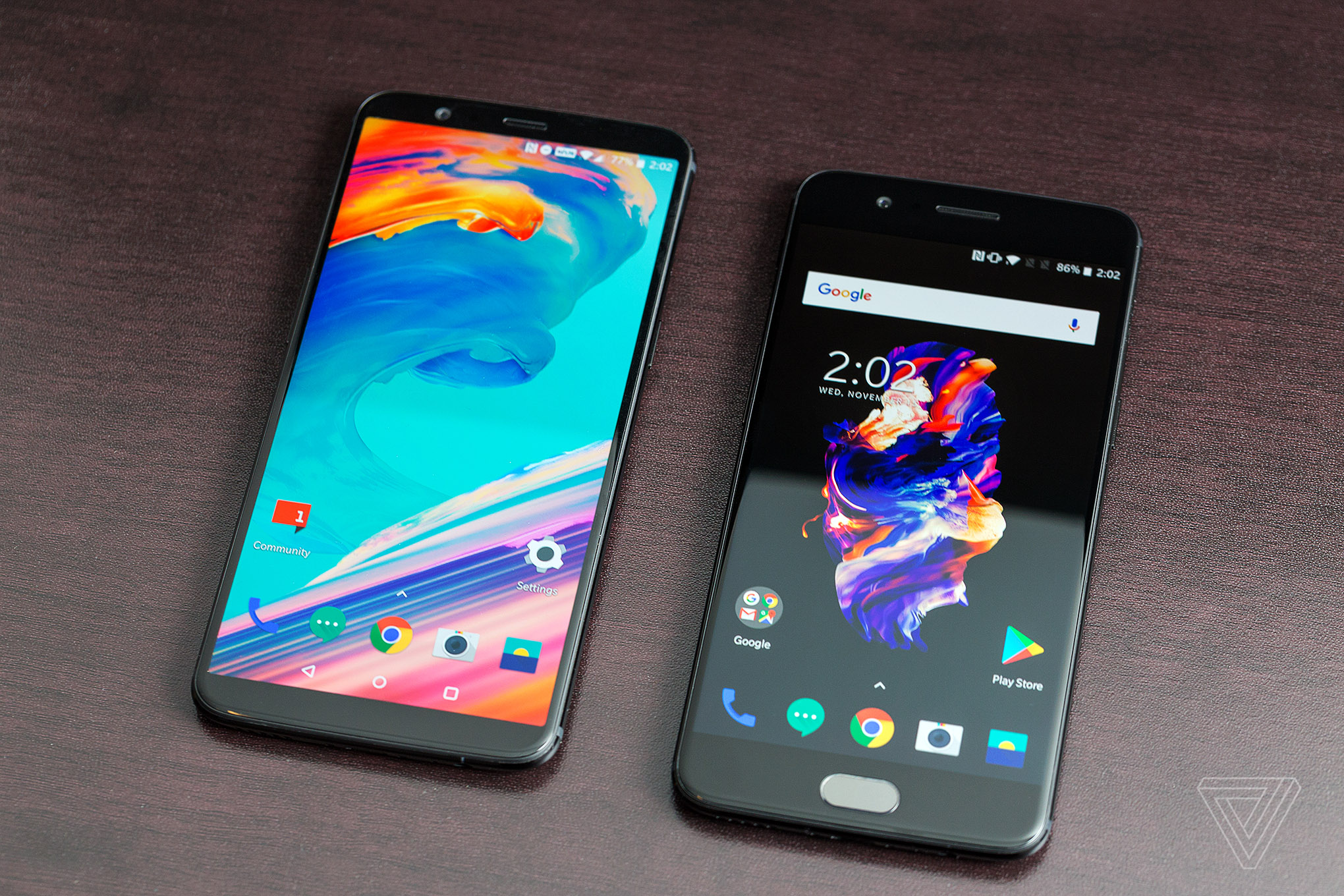
The 5T keeps much of the 5's internal hardware, including the processor, battery and headphone jack, which is becoming so endangered these days. But the screen and camera are what changed most. The 5T's 6-inch AMOLED display now takes up most of the phone face and OnePlus swapped out the 20-megapixel telephoto lens on its dual camera, replacing it with a lens for low light.
Incremental updates have quickly become the OnePlus way. In just four years, this Chinese brand has whipped up a fervent global cult following, based on undercutting the costlier competition. And while the OnePlus 5T isn't as cheap as the first OnePlus flagship in 2014 (when it was $299, or about £180 and AU$320 converted), it's still affordable.

The most noticeable and really only envy-inciting difference between the OnePlus 5 and 5T is the 5T's larger display, which now measures 6 inches instead of 5.5. Because the bezels are thinner, the 5T's physical size remains relatively the same. On paper, it is a few millimeters taller and thicker, and about 0.3 ounces (9 grams) heavier, but I didn't notice a difference in my hand.
With the new size, the display's resolution is still just as sharp (pixels per inch hold steady at 401ppi), but the aspect ratio has gone from 16:9 to 18:9, the same ratio you see in Samsung's Galaxy S8 ($628.00 at Amazon.com) and S8 Plus, LG's V30 and G6, and the Google Pixel 2 XL($849.99 at Best Buy). Some argue that this ratio offers a better, more comfortable viewing experience. But I like it because it gives you a larger canvas for doing all the things you usually do on a phone.
Better low-light camera at the expense of optical zooming
OnePlus made some interesting changes to its dual-camera setup. There's still a 16-megapixel main camera, but what used to be a 20-megapixel telephoto lens now is a lens designed to take better low-light shots.
For camera fans, this secondary lens has the same focal length as the main camera, which means that you can still capture bokeh-style portrait photos, and there won't be any auto-cropping when you take them (something that the OnePlus 5 did). But because OnePlus widened the aperture on the second lens, night-time and lowlight photos look a lot more detailed. The downside though is that telephoto or "optical' zoom is gone, so all the zooming you do on the phone will be carried out digitally.
Specification -
| LAUNCH | Announced | 2017, November |
|---|---|---|
| Status | Available. Released 2017, November |
| BODY | Dimensions | 156.1 x 75 x 7.3 mm (6.15 x 2.95 x 0.29 in) |
|---|---|---|
| Weight | 162 g (5.71 oz) | |
| Build | Front glass, aluminum frame, back | |
| SIM | Dual SIM (Nano-SIM, dual stand-by) |
| DISPLAY | Type | Optic AMOLED capacitive touchscreen, 16M colors |
|---|---|---|
| Size | 6.01 inches, 93.7 cm2 (~80.0% screen-to-body ratio) | |
| Resolution | 1080 x 2160 pixels, 18:9 ratio (~401 ppi density) | |
| Multitouch | Yes | |
| Protection | Corning Gorilla Glass 5 | |
| - DCI-P3 - Oxygen OS 5.0.3 |
| PLATFORM | OS | Android 7.1.1 (Nougat), upgradable to Android 8.0 (Oreo) |
|---|---|---|
| Chipset | Qualcomm MSM8998 Snapdragon 835 | |
| CPU | Octa-core (4x2.45 GHz Kryo & 4x1.9 GHz Kryo) | |
| GPU | Adreno 540 |
| MEMORY | Card slot | No |
|---|---|---|
| Internal | 128 GB, 8 GB RAM or 64 GB, 6 GB RAM |
| CAMERA | Primary | Dual: 16 MP (f/1.7, 27mm, 1/2.8", 1.12 µm, gyro EIS) + 20 MP (f/1.7, 27mm, 1/2.8", 1 µm), phase detection autofocus, dual-LED flash |
|---|---|---|
| Features | Geo-tagging, touch focus, face detection, HDR, panorama | |
| Video | 2160p@30fps, 1080p@30/60fps, 720p@30/120fps | |
| Secondary | 16 MP (f/2.0, 20mm, 1.0 µm), gyro EIS, Auto HDR, 1080p |
| SOUND | Alert types | Vibration; MP3, WAV ringtones |
|---|---|---|
| Loudspeaker | Yes | |
| 3.5mm jack | Yes | |
| - Active noise cancellation with dedicated mic - Dirac HD sound |
| COMMS | WLAN | Wi-Fi 802.11 a/b/g/n/ac, dual-band, WiFi Direct, DLNA, hotspot |
|---|---|---|
| Bluetooth | 5.0, A2DP, LE, aptX HD | |
| GPS | Yes, with A-GPS, GLONASS, BDS, GALILEO | |
| NFC | Yes | |
| Radio | No | |
| USB | 2.0, Type-C 1.0 reversible connector |
| FEATURES | Sensors | Fingerprint (rear-mounted), accelerometer, gyro, proximity, compass |
|---|---|---|
| Messaging | SMS(threaded view), MMS, Email, IM, Push Email | |
| Browser | HTML5 | |
| - Fast battery charging 5V 4A 20W (Dash Charge) - DivX/Xvid/MP4/H.265 player - MP3/eAAC+/WMA/WAV/FLAC player - Document viewer - Photo/video editor |
| BATTERY | Non-removable Li-Po 3300 mAh battery |
|---|
| MISC | Colors | Midnight Black, Lava Red, Sandstone White (128/8GB only) |
|---|---|---|
| Price | About 500 EUR |
| TESTS | Performance | Basemark OS II: 4235 / Basemark OS II 2.0: 3632 Basemark X: 38656 |
|---|---|---|
| Display | Contrast ratio: Infinite (nominal), 4.789 (sunlight) | |
| Camera | Photo / Video | |
| Loudspeaker | Voice 68dB / Noise 73dB / Ring 69dB | |
| Audio quality | Noise -94.0dB / Crosstalk -93.7dB | |
| Battery life |


No comments:
Post a Comment